Dental Fitness Blog · March 19, 2026
What You Drink, Where You Live: Water, Hydration, and Fluoride
A water-first view of prevention — and an honest, evidence-led take on fluoride for rural Texas.
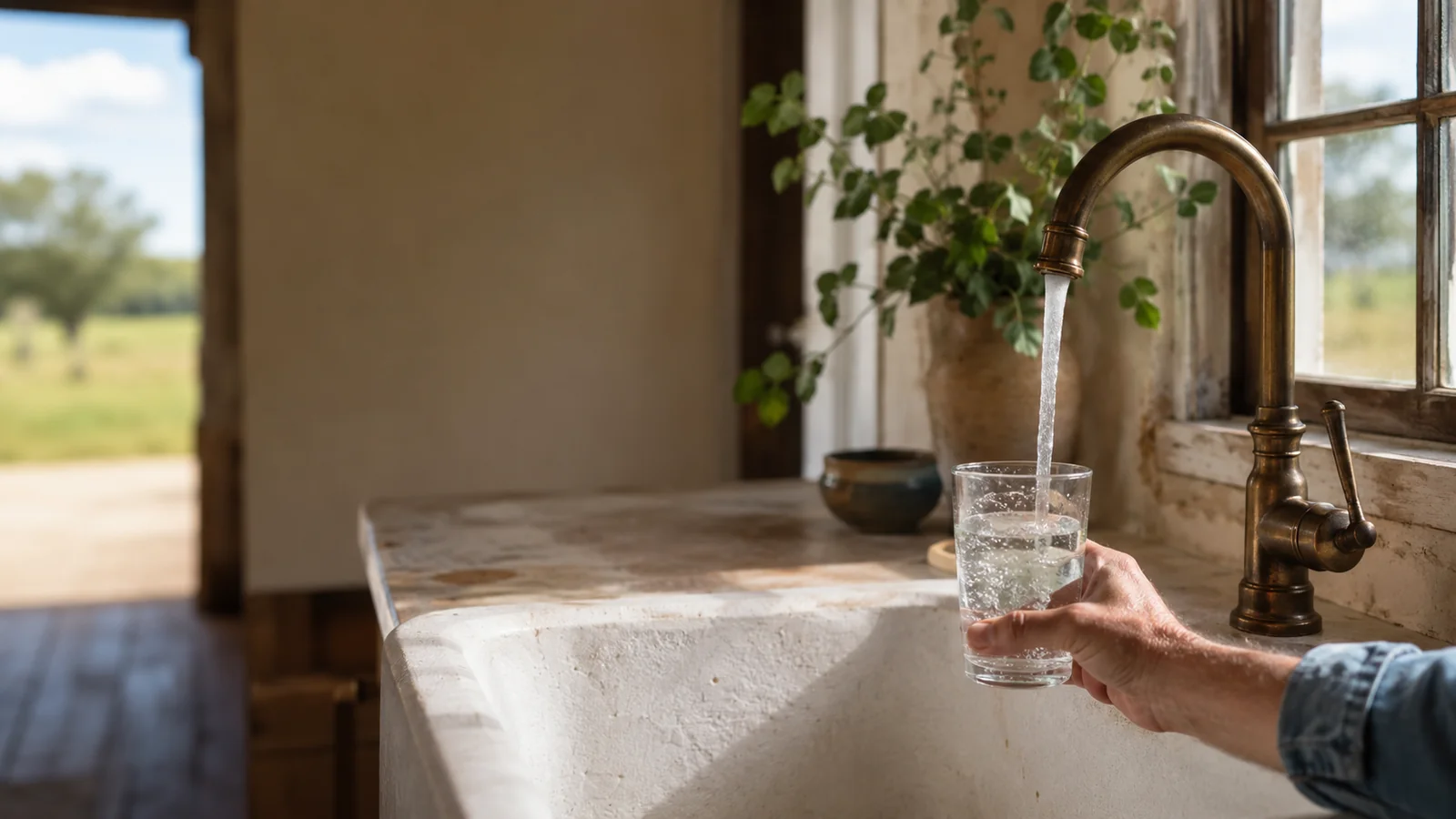
A water-first view of prevention — and an honest, evidence-led take on fluoride for rural Texas.
Out here, water is personal. Some homes are on a treated municipal supply, some on a well, some don't fully trust what comes out of the tap. That matters more for your teeth than most people realize, because in Dental Fitness, water isn't the background of your day — it's one of the main characters.
What you drink, and where you live, quietly shapes your dental risk. Let's talk about both, plainly.
Hydration is a prevention tool
Saliva is your mouth's built-in defense system: it rinses away food, neutralizes acid, and carries the minerals that repair enamel. Staying well hydrated keeps that defense running. Water is the only drink that hydrates without adding sugar or acid, which is why making it your default does two jobs at once — it supports saliva and it displaces the sugary, acidic drinks that drive decay.
There's also a bigger pattern researchers are now documenting: water isn't just one beverage among many; it shapes the whole diet. The June 2026 special issue of the Journal of the Academy of Nutrition and Dietetics was devoted to water and nutrition in a changing world [1]. One study in that body of work found that adults who didn't believe their tap water was safe had different dietary patterns than those who did [2]. When people distrust their water, they often drift toward bottled, flavored, and sweetened drinks — which is worse for teeth. Water trust, it turns out, is a dental issue.
Fluoride: what the evidence actually shows
Fluoride is one of the most studied, most misunderstood topics in all of health, so let me be precise and let the major public-health bodies speak.
Community water fluoridation — adjusting fluoride to a low, optimal level in public water — is supported by the CDC and the American Dental Association as a safe and effective way to reduce tooth decay [3][4]. The CDC's position is that community water fluoridation reduces tooth decay by about 25% in children and adults [3]. As of 2022, 72.3% of the U.S. population served by community water systems — more than 209 million people — had access to fluoridated water [5]. Recent peer-reviewed analysis in JADA reviewed how fluoridation works, how effective it is, and the cost savings it provides at the community level [6].
The ADA has also been clear about the flip side: removing fluoride from community water is projected to increase decay and cost — a real concern in regions debating it [7].
Here's the honest nuance for our area: not every home in rural Texas is on optimally fluoridated water. Wells and some small systems vary widely. That doesn't make fluoride less important — it makes your personal fluoride picture worth a conversation. If your water isn't optimally fluoridated, we simply make sure you're getting appropriate benefit another way, such as fluoride toothpaste and, when indicated, professional applications.
Quick wins
- Make water your default drink. It hydrates, supports saliva, and crowds out sugary/acidic drinks.
- Find out your water source. Municipal, well, or filtered changes your fluoride picture.
- If you don't trust or don't like your tap water, tell us — we'll help you find a safe, tooth-friendly hydration plan instead of defaulting to sweet drinks.
Where it lives, where you live
For families on private wells or non-fluoridated systems, the goal isn't fear — it's a clear plan. Know your water, drink mostly water, and let us fill any fluoride gap deliberately. For everyone, the simplest, most protective hydration habit is also the cheapest one on earth.
Your reps
- Replace one daily sweet or acidic drink with water this week.
- Identify your home water source and whether it's fluoridated; bring the answer to your next visit.
- Keep water visible and within reach where you spend the most time — convenience drives the habit.
What you drink, where you live: small daily water decisions add up to a large share of your dental future. Let's make them work for you.
Evidence & references
How we vet sources: every clinical statement here traces to a peer-reviewed source or an authoritative public-health agency in our citation library. Quantified figures use the agencies' own wording.
- Rosinger AY. Water and nutrition in a rapidly changing world: Introduction to the special issue. J Acad Nutr Diet. 2026;126(6):156319. doi:10.1016/j.jand.2026.156319.
- Slotnick MJ, Leung CW, Tucker AC, Jones AD, Wolfson JA. Associations Between Perceived Tap Water Safety and Dietary Outcomes Among US Adults. J Acad Nutr Diet. doi:10.1016/j.jand.2025.07.004.
- Centers for Disease Control and Prevention. CDC Scientific Statement on Community Water Fluoridation. May 15, 2024.
- American Dental Association. American Dental Association Reaffirms Support for Community Water Fluoridation. August 26, 2024.
- Centers for Disease Control and Prevention. Community Water Fluoridation Facts. May 15, 2024.
- Warren JJ, Levy SM, Kumar JV. An update on community water fluoridation, part 1: Mechanism of action, effectiveness, and cost savings. J Am Dent Assoc. 2026;157(4):334–343. doi:10.1016/j.adaj.2026.01.009. PMID:41746238.
- American Dental Association. Removal of Fluoride from Water Will Cost Billions and Deteriorate Oral Health. May 30, 2025.
By Dr. Jarred K. Donald, DDS, FAGD · Cisco Dental, PLLC · Cisco, TX · Last reviewed May 31, 2026. Educational information, not a substitute for an individual evaluation.
Water & Fluoride
Prevention
Educational content only, and not a substitute for in-office clinical evaluation.