Dental Fitness Blog · August 1, 2026
It's Not How Much Sugar — It's How Often
Seventy years of research agrees: the frequency of sugar exposure drives tooth decay more than the amount. A Cisco, TX dentist explains the acid clock inside your mouth.
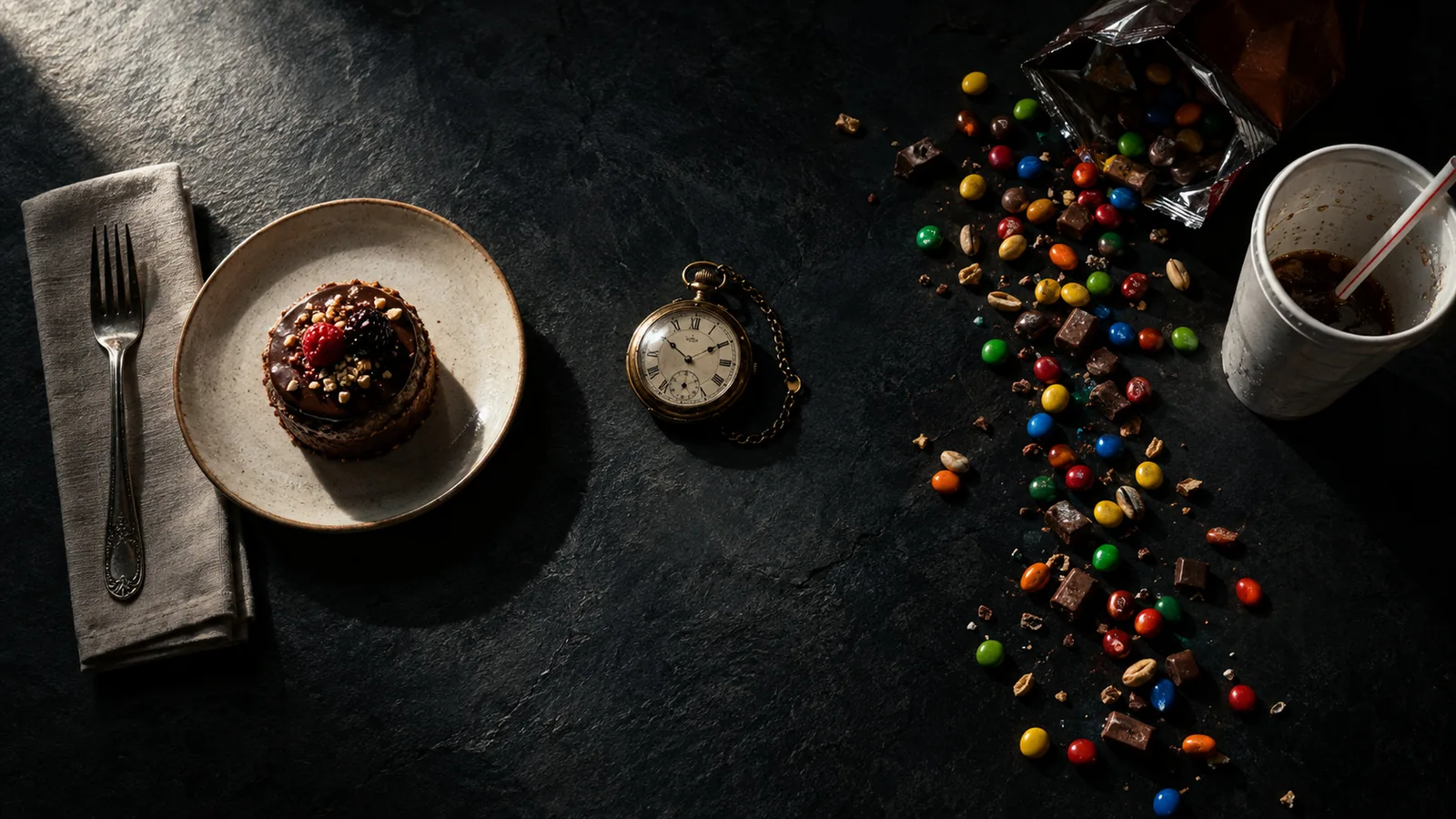
If I could put one sentence on a billboard outside every school in Eastland County before classes start this month, it would be this one:
Your teeth don't count grams of sugar. They count acid attacks.
Two patients can eat the exact same amount of sugar in a day and end up with completely different mouths. The one who eats it in ten minutes may stay cavity-free for years. The one who spreads it across the afternoon can decay steadily. That isn't a hunch from my operatory — it's one of the oldest and best-replicated findings in dental science.
The acid clock: what happens after every bite
In the 1940s, researcher Robert Stephan measured the pH of dental plaque after a sugar exposure and documented what is now taught in every dental school as the Stephan curve (Stephan, 1944). Within minutes of sugar contact, plaque bacteria ferment it into acid, and the pH at the tooth surface plunges — frequently below the critical threshold of about 5.5 where enamel mineral dissolves. Then, over roughly the next half hour or more, saliva gradually neutralizes the acid and the pH climbs back to safety.
Read that again with a clock in mind. One candy bar eaten in five minutes triggers one acid attack lasting on the order of half an hour. The same candy bar eaten square by square across the afternoon triggers attack after attack after attack — and between them, your enamel never gets the recovery window it needs to remineralize.
The sugar was identical. The damage was not.
The study that proved it
The landmark evidence comes from the Vipeholm study, conducted in Sweden and published in 1954 (Gustafsson et al., 1954). Researchers followed hundreds of institutionalized adults for years under controlled diets — a study design, I should say plainly, that was conducted without meaningful consent and would be ethically impermissible today. But its findings reshaped preventive dentistry worldwide:
Sugar consumed with meals produced only a small increase in decay. Sugar consumed between meals — especially in sticky, slow-clearing forms like toffee — produced a dramatic increase. And when the between-meal sweets stopped, decay activity dropped sharply.
Frequency and form beat quantity. Modern evidence still supports keeping total intake down, too: the systematic review underpinning the World Health Organization's guideline found consistently lower decay when free sugars stay below 10% of daily calories (Moynihan & Kelly, 2014; WHO, 2015). But between two mouths consuming the same total, the grazer loses.
The modern problem: we've become a grazing culture
Vipeholm's toffee has become today's desk candy, drive-through sweet tea, sports drink on the sideline, and energy drink nursed across a shift. Liquid sugar counts double here, because sipping restarts the acid clock exactly the way snacking does — a point we made in June about acid, and it's just as true for sugar. A 44-ounce soda sipped across a Texas afternoon may be the single most efficient tooth-destroying habit ever invented: hour after hour of simultaneous sugar and acid exposure with no recovery window at all.
And here in Cisco, remember our local twist: our community water isn't fluoridated, so our enamel repairs with less help than most. The recovery window isn't a nicety for us. It's the whole ballgame.
The Dental Fitness® playbook
Notice that none of this requires giving up sugar. It requires scheduling it. Keep sweets and sweet drinks with meals, when salivary flow is already high. Finish them — twenty minutes of dessert beats four hours of grazing. Between meals, make plain water the default. Give your mouth at least a couple of hours of quiet between sugar exposures so the Stephan curve can complete its recovery. And guard bedtime absolutely: after the nighttime brush, water only.
Back-to-school season is when snack habits get set for the year — for the kids and for us. This August, don't count grams. Count attacks. Then cut the number of attacks in half.
Your enamel will handle the rest.
Dr. Jarred Donald practices at Cisco Dental Associates in Cisco, Texas, and is the originator of the Dental Fitness® framework.
References
- Stephan RM. Intra-oral hydrogen-ion concentrations associated with dental caries activity. J Dent Res. 1944;23(4):257–266.
- Gustafsson BE, Quensel CE, Lanke LS, et al. The Vipeholm dental caries study: the effect of different levels of carbohydrate intake on caries activity in 436 individuals observed for five years. Acta Odontol Scand. 1954;11(3–4):232–364.
- Moynihan PJ, Kelly SAM. Effect on caries of restricting sugars intake: systematic review to inform WHO guidelines. J Dent Res. 2014;93(1):8–18.
- World Health Organization. Guideline: Sugars Intake for Adults and Children. Geneva: WHO; 2015.
Educational content only, and not a substitute for in-office clinical evaluation.