Dental Fitness Blog · February 19, 2026
Prevention Is Predictable
The philosophy behind everything we do: treat oral health like fitness — proactive, trainable, and measured over time.
The philosophy behind everything we do: treat oral health like fitness — proactive, trainable, and measured over time.
There's an old model of dentistry where you wait for something to hurt, come in, and get it fixed. It's reactive, it's expensive, and it tends to repeat. Dental Fitness is the other model. It treats your mouth the way a good coach treats an athlete's body: something you train and maintain on purpose, so the emergencies mostly never happen.
The phrase I keep coming back to is simple. Most dental disease is preventable. Most dental disease is also predictable. Once you accept both halves of that sentence, the whole approach to care changes.
Cavities are a process, not an event
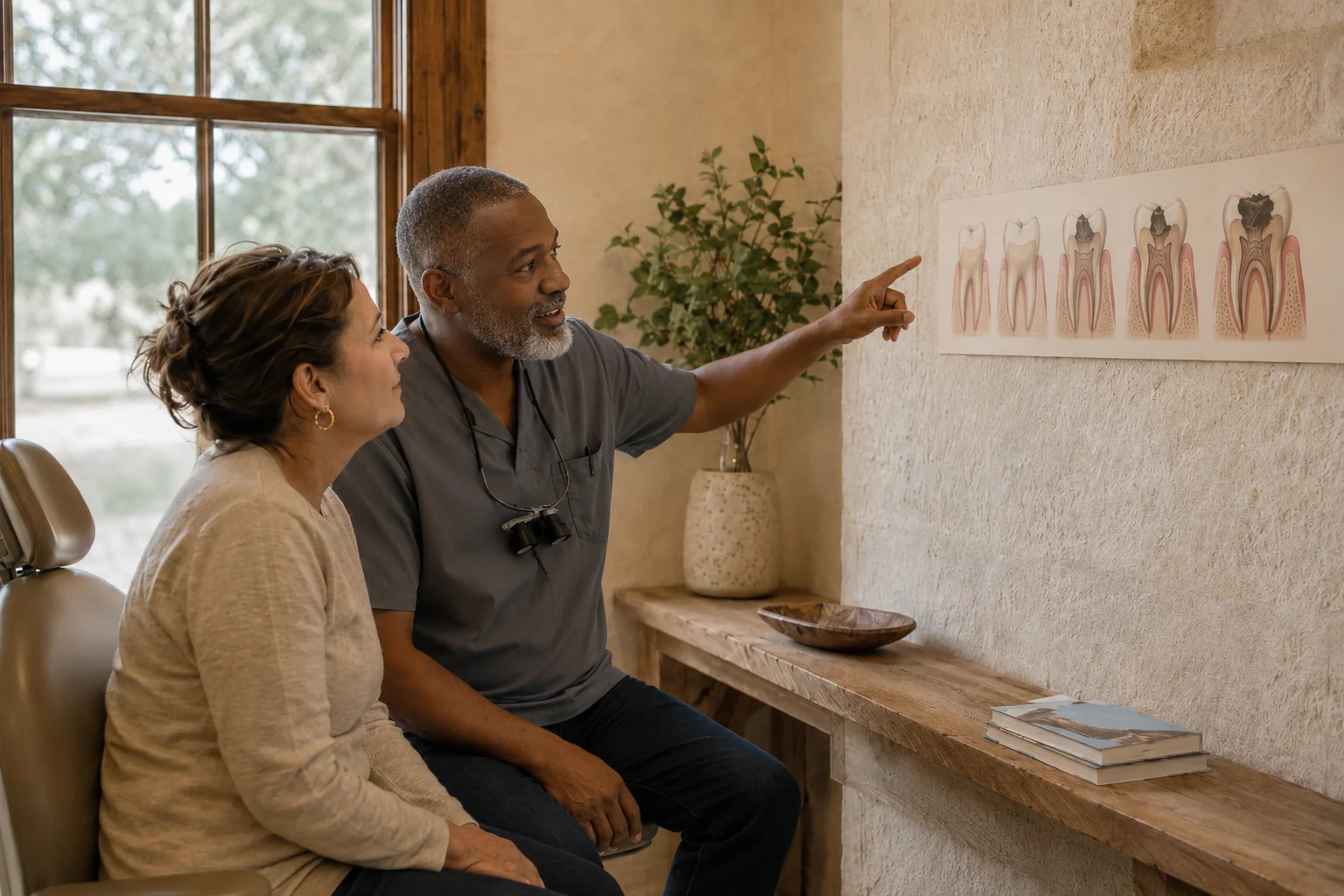
We tend to talk about a cavity as if it appears one day, fully formed. It doesn't. Tooth decay is a dynamic process — a long back-and-forth between minerals leaving enamel (demineralization) and minerals returning to it (remineralization) [1]. A tooth can spend months or years tipping slightly one way or the other before a hole ever forms.
That's actually wonderful news, because it means there's a long window where the balance can be tipped back. The American Dental Association's own caries classification system describes decay along a continuum — from the very earliest, reversible changes through to advanced lesions — precisely so that early disease can be managed rather than only drilled [2]. Current evidence reviews reinforce that early enamel changes can often be remineralized with the right daily habits and fluoride exposure before they ever need a filling [3].
"Predictable" is the part people miss
Prevention isn't a coin flip. Your individual risk is largely knowable. It comes from things we can actually look at together: what you drink all day, how often sugar or acid hits your teeth, your fluoride exposure, how much saliva you make, your gum health, your medical conditions and medications, and how consistently you keep your maintenance visits.
When we understand those inputs, we can predict — with real confidence — whether you're trending toward trouble or toward stability, and we can change the trajectory long before it becomes a crown or a root canal. That's what "predictable" means in practice: not fortune-telling, but reading the same signals every time and acting on them early.
Common sense, made clinical
I don't think prevention should feel mysterious or sales-y. The most powerful tools are unglamorous: water as your default drink, a soft brush twice a day, cleaning between your teeth, sensible fluoride, and showing up for maintenance. What we add is the clinical layer — measuring your real risk, catching the early signal, and tailoring the plan to your life instead of handing you a generic pamphlet.
Quick wins
- Think in trends, not crises: small daily habits decide most outcomes.
- Ask at your next visit, "What's my actual risk, and what's driving it?"
- Treat the earliest spot we find as a chance to reverse course, not a sentence.
You're training a system, not rescuing a tooth
The reason we look at the whole system — diet, saliva, gums, habits, history — is that the tooth in front of us is usually just the loudest symptom of something upstream. Fix the upstream pattern and you stop generating the same problem over and over.
Your reps
- Pick your single biggest known risk (often a daily drink or a skipped-floss habit) and improve just that one.
- Lock in your maintenance interval and actually keep it — consistency beats intensity.
- Bring questions to your visit. Prevention works best as a conversation, not a monologue.
Prevention is predictable. Let's train it together — and keep most of the hard dentistry from ever being necessary.
Evidence & references
How we vet sources: every clinical statement here traces to peer-reviewed literature or an authoritative public-health source in our citation library. No claim ships without one.
- Featherstone JDB. Dental caries: a dynamic disease process. Aust Dent J. 2008;53(3):286–291.
- Young DA, Nový BB, Zeller GG, et al. The American Dental Association Caries Classification System for Clinical Practice. J Am Dent Assoc. 2015;146(2):79–86. doi:10.1016/j.adaj.2014.11.018.
- Lawson NC. Current Evidence for Caries Prevention and Enamel Remineralization. Compend Contin Educ Dent. 2025;46(3):128–134. PMID:40049613.
By Dr. Jarred K. Donald, DDS, FAGD · Cisco Dental, PLLC · Cisco, TX · Last reviewed May 31, 2026. Educational information, not a substitute for an individual evaluation.
Prevention
Prevention
Dental Fitness
Preventi/markdown
on
Educational content only, and not a substitute for in-office clinical evaluation.