Dental Fitness Blog · March 3, 2026
Most of What We Fix Starts With What You Drink All Day
A prevention-first look at the one habit that quietly drives most of the dentistry we end up doing.
A prevention-first look at the one habit that quietly drives most of the dentistry we end up doing.
After more than two decades in practice, I can tell you that most of what we repair in a dental chair doesn't start in the chair. It starts at a kitchen counter, a truck cup holder, or a desk — with whatever someone sips on, a little at a time, all day long. That is the heart of what we call Dental Fitness: looking at the system that produces the problem, not just the tooth in front of us.
The good news is that this is one of the most changeable risks in all of medicine. You don't have to be perfect. You have to understand what's happening and adjust the pattern.
It's the frequency, not just the sugar
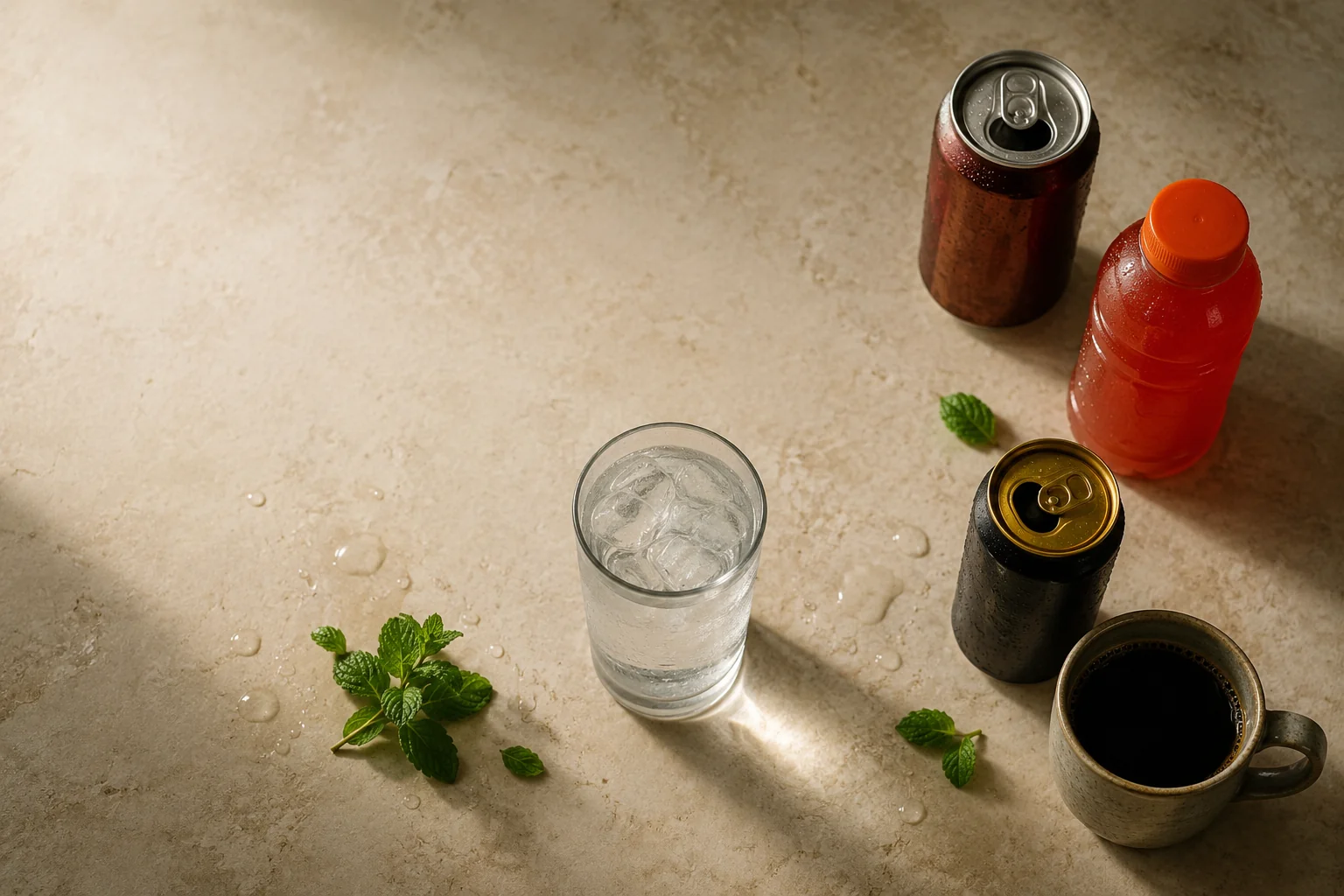
Teeth don't mind an occasional treat nearly as much as they mind a constant one. Every time a sugary drink crosses your lips, the bacteria in dental plaque turn that sugar into acid, and that acid pulls minerals out of enamel for a stretch of time afterward. Sip every twenty minutes and your enamel rarely gets to recover.
This isn't an opinion. In a four-year prospective study of adults, higher sugar-sweetened beverage intake was associated with more dental decay over time [1]. The same association shows up in children and adolescents [2], and it's consistent enough that the American Dental Association and clinical reviews specifically flag sugar-sweetened beverages as a modifiable caries risk [3][4].
Acid does damage even without sugar
Here's the part patients rarely hear: a drink doesn't need sugar to be hard on enamel. It needs to be acidic. Many sodas, sports drinks, energy drinks, citrus waters, and even some "healthy" beverages sit well below the point at which enamel begins to dissolve. Enamel starts to demineralize once the mouth drops under roughly pH 5.5 — the long-established critical pH for enamel [5] — and laboratory analyses confirm that a wide range of everyday drinks and even some medications are erosive [6].
That's why a zero-sugar energy drink or a squeeze-of-lemon water all day can still wear teeth down. Sugar drives cavities; acid drives erosion. Many popular drinks deliver both.
Water is the boring answer, and the right one
The most protective beverage habit is also the least glamorous: make water your default, and treat everything else as an occasional choice rather than an all-day companion. Water has a neutral pH, no sugar, and in many communities it carries fluoride that actively helps enamel — a topic worth its own post.
This is the thinking behind BeverageIQ, our educational way of talking with patients about what they drink. It is a conversation tool, not a diagnosis or a product pitch — a simple way to look honestly at your daily beverage pattern and find one or two realistic swaps. Prevention works best when it's specific to your day, not a lecture.
Quick wins
- Make water your default drink; let everything else be a "sometimes" choice.
- If you have a sugary or acidic drink, have it with a meal rather than sipping it for hours.
- Use a straw for acidic drinks, and rinse with plain water afterward.
- Don't brush immediately after an acidic drink — wait about 30–60 minutes so softened enamel can re-harden first.
The Dental Fitness way to think about it
Dental Fitness treats your mouth like something you train, not something you rescue. You don't need a perfect diet. You need to know which daily pattern is quietly working against you and change that one thing. For most people, the highest-yield change in the whole mouth is the drink they reach for without thinking.
Your reps
- For three days, notice every drink that isn't water. Just notice — no judgment.
- Pick the single most frequent sugary or acidic drink and cut its frequency in half.
- Keep a full water bottle within arm's reach where you spend the most time.
We'd rather coach the why with you than drill and fill on a loop. Bring your real beverage habits to your next visit and we'll build a plan around them.
Evidence & references
How we vet sources: every clinical statement here traces to peer-reviewed literature or an authoritative public-health source in our citation library. No claim ships without one.
- Bernabé E, Vehkalahti MM, Sheiham A, Aromaa A, Suominen AL. Sugar-sweetened beverages and dental caries in adults: a 4-year prospective study. J Dent. 2014;42(8):952–958. doi:10.1016/j.jdent.2014.04.011. PMID:24813370.
- Pitchika V, Standl M, Harris C, et al. Association of sugar-sweetened drinks with caries in 10- and 15-year-olds. BMC Oral Health. 2020;20(1):81. doi:10.1186/s12903-020-01068-9. PMID:32192461.
- Marshall TA. Preventing dental caries associated with sugar-sweetened beverages. J Am Dent Assoc. 2013;144(10):1148–1152. doi:10.14219/jada.archive.2013.0033.
- American Dental Association. Nutrition and Oral Health. ADA Oral Health Topics. https://www.ada.org/resources/ada-library/oral-health-topics/nutrition-and-oral-health
- Hara AT, Zero DT. The caries environment: saliva, pellicle, diet, and hard tissue ultrastructure. Dent Clin North Am. 2014;58(4):739–751.
- Lussi A, Megert B, Shellis RP, et al. Analysis of the erosive effect of different dietary substances and medications. Br J Nutr. 2012;107(2):252–262.
By Dr. Jarred K. Donald, DDS, FAGD · Cisco Dental, PLLC · Cisco, TX · Last reviewed May 31, 2026. Educational information, not a substitute for an individual evaluation.
Educational content only, and not a substitute for in-office clinical evaluation.