Dental Fitness Blog · March 24, 2026
Enamel Is a Living Mineral
The science of remineralization — and why your enamel is far more repairable than you were taught.
The science of remineralization — and why your enamel is far more repairable than you were taught.
Most of us grew up picturing enamel as a hard, dead shell — once it chips or decays, it's gone for good. That picture is only half right. Enamel is indeed the hardest substance your body makes, but it is also a mineral in constant exchange with the fluids around it. Minerals leave the surface; minerals come back. Your daily choices tip that balance.
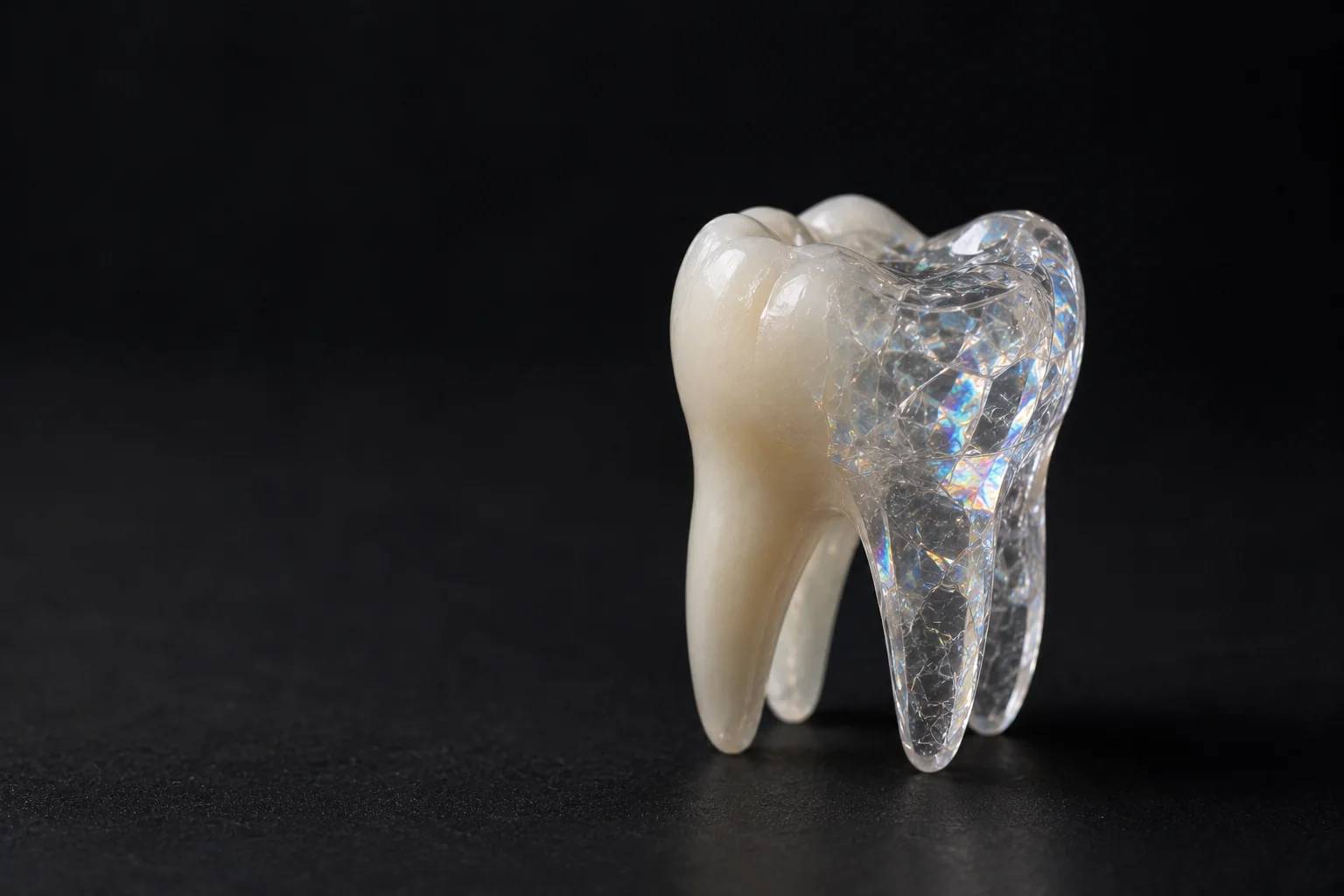
Picture a tooth as a crystal lattice. All day long, that lattice is either losing structure or rebuilding it. Dental Fitness is, at its core, the practice of keeping that exchange tilted toward rebuilding.
Demineralization and remineralization: the daily tug-of-war
When acid washes over enamel — from bacteria fermenting sugar, or from acidic drinks — the surface loses calcium and phosphate. That's demineralization. When conditions turn favorable again, those minerals (often helped by fluoride) redeposit into the lattice. That's remineralization. Tooth decay is simply this tug-of-war tipping the wrong way for too long — a dynamic disease process, not a sudden event [1].
The threshold matters. Enamel begins to dissolve once the mouth drops below roughly pH 5.5, the long-recognized critical pH for the caries environment [2]. Stay above it most of the day and your enamel spends most of its time rebuilding. Spend hours below it — sip-by-sip — and demineralization wins.
How minerals rebuild the lattice
Three players do most of the rebuilding work, and the science behind each is well established:
- Fluoride doesn't just "harden" teeth in a vague way. It drives remineralization and helps form a more acid-resistant mineral at the enamel surface — a mechanism worked out in detail decades ago and still central to caries prevention [3].
- Calcium and phosphate are the raw materials of enamel itself. Delivering them to the surface supports reformation of the mineral structure, which is why calcium-phosphate–based systems have been studied as remineralization aids [4].
- A favorable environment — adequate saliva, neutral pH, and time between acid attacks — lets all of the above actually happen.
Put simply: give enamel the right minerals, in the right conditions, with enough recovery time, and early damage can heal before it ever becomes a cavity. Current evidence reviews confirm that early, non-cavitated enamel lesions can often be remineralized rather than restored [5].
What this changes for you
This is the most hopeful idea in preventive dentistry: the earliest decay is reversible. When we catch a white-spot lesion or early softening, the goal isn't always a filling — it's frequently to change the conditions and let the tooth repair itself. That's a different, calmer conversation than "you have a cavity."
Quick wins
- Use fluoride deliberately — toothpaste, and fluoridated water where you have it. It's the most evidence-backed remineralization tool you own.
- Give your enamel recovery time: cluster sweets/acids with meals instead of grazing all day.
- After acidic drinks, rinse with plain water and wait before brushing so softened enamel can re-harden.
The Dental Fitness view of enamel
When you understand enamel as a living mineral, prevention stops feeling like nagging and starts feeling like training. You're not just "avoiding cavities" — you're managing a surface you can measurably strengthen. That's why we look for the earliest signal and treat it as an opportunity, not a failure.
Your reps
- Brush twice daily with fluoride toothpaste and don't rinse heavily afterward — let a little stay on the teeth.
- Build acid-free recovery windows into your day (water between meals, not constant sipping).
- Ask us about your enamel at your next visit — if there's an early spot, let's try to reverse it.
Your enamel is alive in the ways that matter. Let's keep it building.
Evidence & references
How we vet sources: every clinical statement here traces to peer-reviewed literature in our citation library. In vitro and laboratory mechanisms are described as mechanisms, not as guaranteed individual outcomes.
- Featherstone JDB. Dental caries: a dynamic disease process. Aust Dent J. 2008;53(3):286–291.
- Hara AT, Zero DT. The caries environment: saliva, pellicle, diet, and hard tissue ultrastructure. Dent Clin North Am. 2014;58(4):739–751.
- ten Cate JM. Current concepts on the theories of the mechanism of action of fluoride. Acta Odontol Scand. 1999;57(6):325–329.
- Reynolds EC. Calcium phosphate-based remineralization systems: scientific evidence? Aust Dent J. 2008;53(3):268–273.
- Lawson NC. Current Evidence for Caries Prevention and Enamel Remineralization. Compend Contin Educ Dent. 2025;46(3):128–134. PMID:40049613.
By Dr. Jarred K. Donald, DDS, FAGD · Cisco Dental, PLLC · Cisco, TX · Last reviewed May 31, 2026. Educational information, not a substitute for an individual evaluation.
Remineralization
Prevention
Educational content only, and not a substitute for in-office clinical evaluation.