Dental Fitness Blog · October 1, 2026
Electric vs. Manual Toothbrush: What 56 Clinical Trials Actually Say
A Cochrane review of 56 trials found powered toothbrushes reduce plaque and gingivitis more than manual brushing. A Cisco, TX dentist breaks down what that means for you.
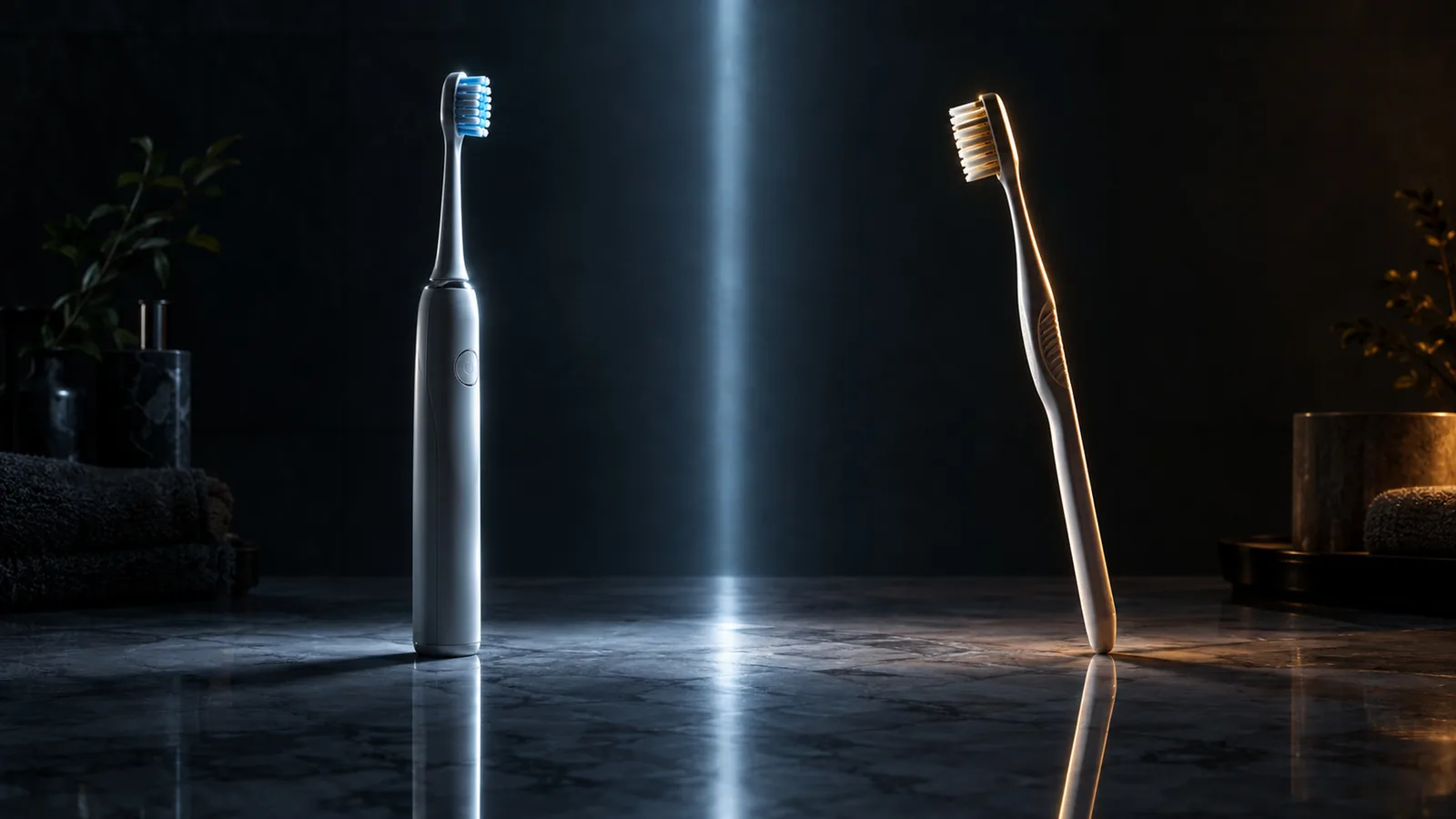
It's one of the questions I'm asked most often, usually right at the end of a checkup, hand on the doorknob: "Doc, is an electric toothbrush really worth it?"
Most dental advice columns answer this with opinion. Let's answer it with the strongest evidence format medicine has: a Cochrane systematic review.
The evidence
Cochrane reviews are the gold standard for weighing clinical research — independent, methodical, and conservative by design. The Cochrane review on this exact question pooled 56 randomized trials involving 5,068 participants comparing powered and manual toothbrushes (Yaacob et al., 2014). The findings:
Plaque: powered toothbrushes reduced plaque 11% more than manual brushes at one to three months of use, and 21% more when studies ran beyond three months.
Gingivitis: powered brushes reduced gingivitis (early gum inflammation, the bleeding stage that precedes periodontitis) 6% more at one to three months and 11% more beyond three months.
Notice the pattern: the powered brush's advantage grew with time. That's the signature of a technology compensating for human nature — on any single morning a skilled manual brusher can match a machine, but across hundreds of brushing sessions, the machine's consistency wins. The strongest evidence in the review involved oscillating-rotating brushes (the small round heads that spin back and forth), though several designs showed benefit.
The honest caveats
Tenured-professor honesty requires the fine print, so here it is. These are percentage reductions in plaque and gingivitis scores — reliable, measurable, and meaningful, but not a force field. The review could not tell us whether powered brushing prevents more cavities over a lifetime; trials that long are impractical to run. And a powered brush used for twenty rushed seconds will lose to a manual brush used well for two minutes, every time.
In other words: the brush matters. The brusher matters more.
So what do I actually recommend?
After over 26 years of looking into mouths, here's how I translate the evidence chairside.
A powered brush earns its cost for most people — and it's close to essential for some. If you have a history of gum disease, wear braces, struggle with dexterity from arthritis, Parkinson's, or a stroke, or you're a parent supervising a child's brushing, the built-in consistency of a powered brush is working hardest for exactly you. The two-minute timer alone fixes the most common failure I see: most people who think they brush for two minutes are done in well under one.
A manual brush in disciplined hands is still a fine instrument. If your checkups are consistently clean and your gums don't bleed, your technique is proving itself — don't let anyone shame you into an upgrade you don't need.
Either way, the fundamentals don't change. Soft bristles — stiff bristles wear teeth and gums, they don't clean better. Two minutes, twice a day, with fluoride toothpaste — which, in a non-fluoridated town like Cisco, is your single most important daily protection. Angle the bristles toward the gumline, let the brush do the work without scrubbing pressure, and replace the brush or the head when the bristles splay — about every three months. And remember that no brush of any kind reaches between the teeth; that's the job of floss or interdental brushes, every day.
The Dental Fitness® bottom line
Think of it in training terms, because that's what Dental Fitness® is: a manual brush is a set of free weights, and a powered brush is a well-designed machine at the gym. Both build strength. The machine makes good form automatic.
If you're buying one this month — and October's candy season is a fine month to upgrade your defense — look for a powered brush with a two-minute timer, use soft heads, and bring it up at your next visit. We'll check your results against the only scoreboard that matters: your own plaque and gum scores, visit over visit.
That's not marketing. That's measurement.
Dr. Jarred Donald practices at Cisco Dental Associates in Cisco, Texas, and is the originator of the Dental Fitness® framework.
References
- Yaacob M, Worthington HV, Deacon SA, et al. Powered versus manual toothbrushing for oral health. Cochrane Database Syst Rev. 2014;(6):CD002281.
Educational content only, and not a substitute for in-office clinical evaluation.