Dental Fitness Blog · May 29, 2026
A Small Shield for Big Molars: The Case for Sealants
A small, painless, preventive step that fits the Dental Fitness philosophy perfectly.
A small, painless, preventive step that fits the Dental Fitness philosophy perfectly.
If I could put one simple idea at the front of every parent's mind, it would be this: the cheapest cavity is the one that never starts. Dental sealants are one of the clearest examples of that principle in action — a quick, painless coating that protects the teeth most likely to decay, before anything goes wrong.
Sealants are about as Dental Fitness as it gets. They don't fix damage; they prevent it. They work with the tooth instead of waiting to repair it.
Why molars need help
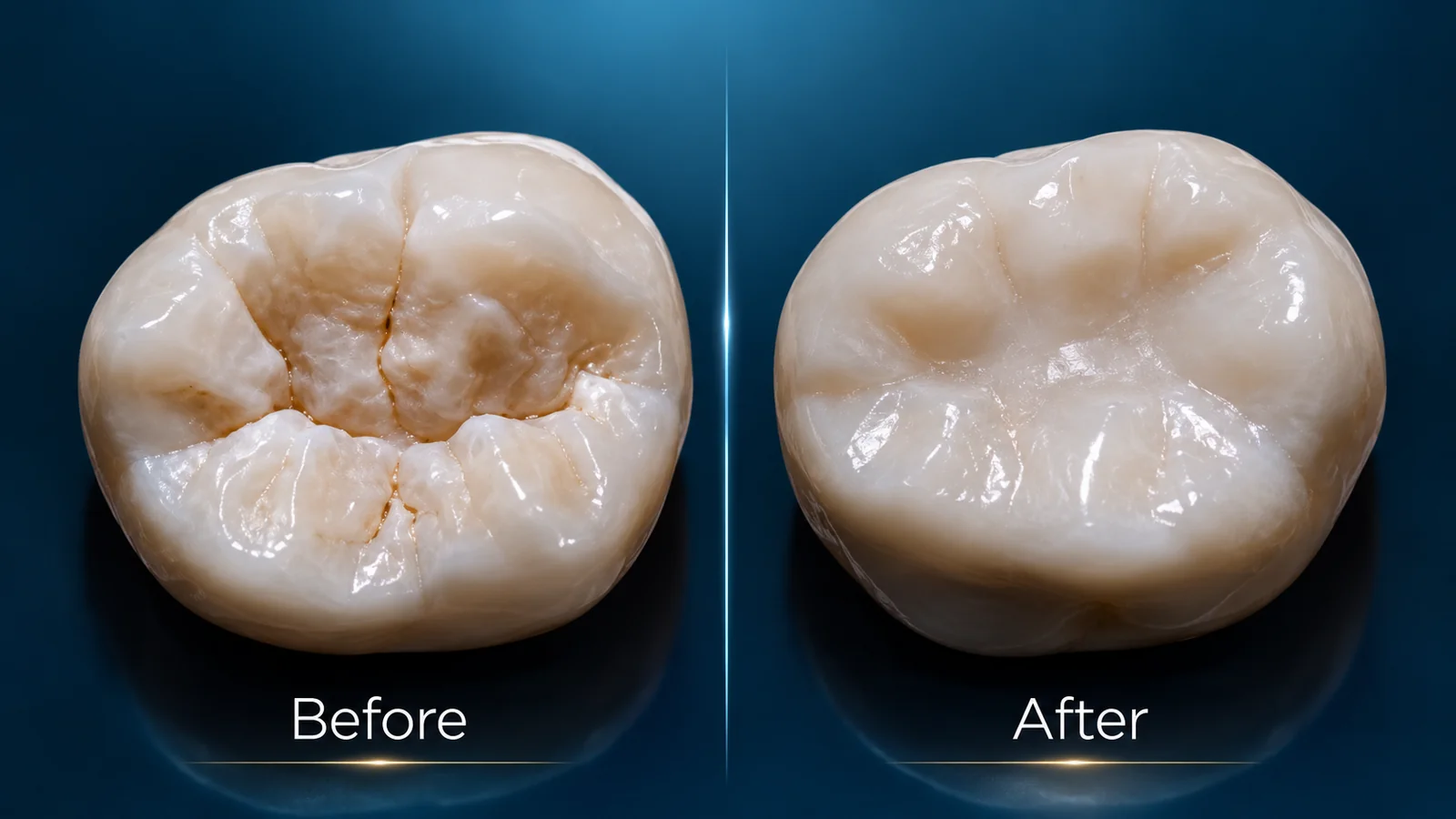
Look closely at a back tooth and you'll see deep grooves and pits across the chewing surface. Those grooves are wonderful for grinding food and terrible for cleaning — they're often narrower than a single toothbrush bristle. Food and bacteria settle in, and no amount of careful brushing fully reaches the bottom. That's exactly where decay tends to begin, especially on the newly erupted molars of children and teenagers.
A sealant is a thin protective coating flowed into those grooves and bonded in place. It turns a rough, food-trapping surface into a smooth one that's far easier to keep clean. The application is fast, completely painless, and requires no drilling and no numbing.
What the evidence says
Sealing the chewing surface is a well-established, evidence-based way to reduce decay on those at-risk surfaces. In a recent randomized clinical trial, researchers compared sealants against silver diamine fluoride and found both meaningfully reduced cavities in children — strong evidence that protecting the grooves works [1].
That same body of research is worth knowing about for another reason: it gives us options. Silver diamine fluoride (SDF) is a brush-on liquid that can arrest and help prevent decay, and systematic reviews support its role as a caries-preventing and caries-arresting agent [2]. For a young or anxious child, a child who can't sit for traditional treatment, or a tooth that's hard to seal well, SDF can be a gentle, effective alternative or complement. Choosing between them is exactly the kind of individualized decision we like to make with families, guided by the same ADA caries-management framework we use throughout prevention [3].
Quick wins
- Ask whether your child's permanent molars are good candidates for sealants soon after they come in.
- Sealants complement — not replace — brushing, fluoride, and smart drink habits.
- For a child who struggles with treatment, ask about silver diamine fluoride as a gentler option.
Not just for kids
We most often seal children's molars because that's where the timing and the risk line up, but the principle applies to adults too. An adult with deep grooves, a high cavity history, or hard-to-clean surfaces may also benefit. The question is always the same: is this surface at real risk, and is there a simple way to protect it before it fails?
The Dental Fitness fit
Sealants embody the whole philosophy in miniature: look ahead, find the predictable risk, and spend a small, painless effort now to avoid a larger one later. That's prevention that's predictable — and kind to the patient sitting in the chair.
Your reps
- At your child's next visit, ask, "Are these molars sealant candidates yet?"
- Keep up the fundamentals — sealants protect grooves, but smooth surfaces still need brushing, flossing, and water-first habits.
- If treatment is hard for your child, ask us about SDF so prevention doesn't have to wait.
A small shield, placed at the right time, can save a lifetime of repairs. Let's protect those molars before they ever need fixing.
Evidence & references
How we vet sources: every clinical statement here traces to peer-reviewed literature or an authoritative source in our citation library. No claim ships without one.
- Ruff RR, Barry Godín TJ, Niederman R. Noninferiority of Silver Diamine Fluoride vs Sealants for Reducing Dental Caries Prevalence and Incidence: A Randomized Clinical Trial. JAMA Pediatr. 2024;178(4):354–361. doi:10.1001/jamapediatrics.2023.6770. PMID:38436947.
- Alqalaleef SS, Alnakhli RA, Ezzat Y, et al. The role of silver diamine fluoride as dental caries preventive and arresting agent: a systematic review and meta-analysis. Front Oral Health. 2024;5:1492762. doi:10.3389/froh.2024.1492762. PMID:39659492.
- Young DA, Nový BB, Zeller GG, et al. The American Dental Association Caries Classification System for Clinical Practice. J Am Dent Assoc. 2015;146(2):79–86. doi:10.1016/j.adaj.2014.11.018.
By Dr. Jarred K. Donald, DDS, FAGD · Cisco Dental, PLLC · Cisco, TX · Last reviewed May 31, 2026. Educational information, not a substitute for an individual evaluation.
Children's Dentistry
Preventi/markdown
on
Educational content only, and not a substitute for in-office clinical evaluation.